CARECLIM Product Range
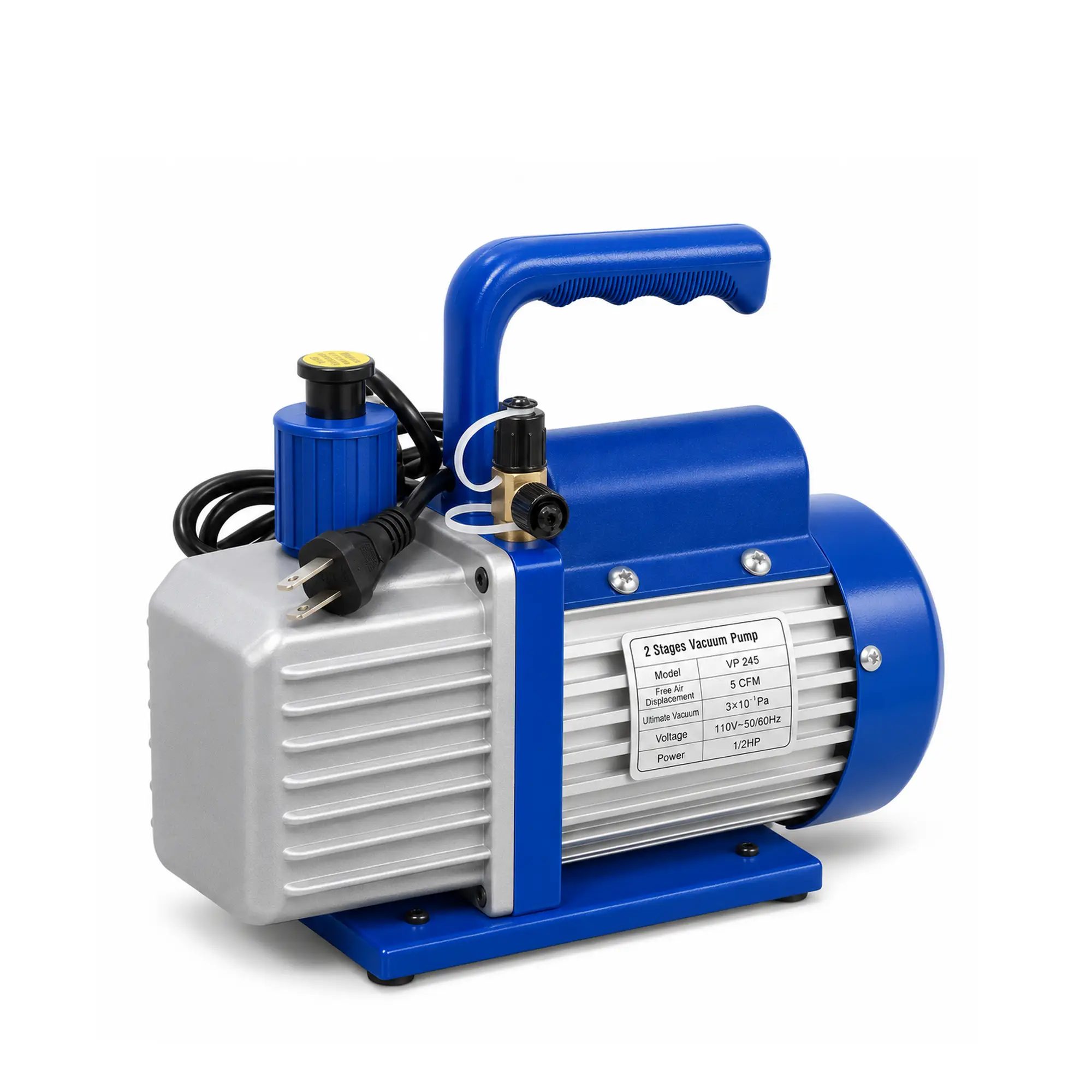
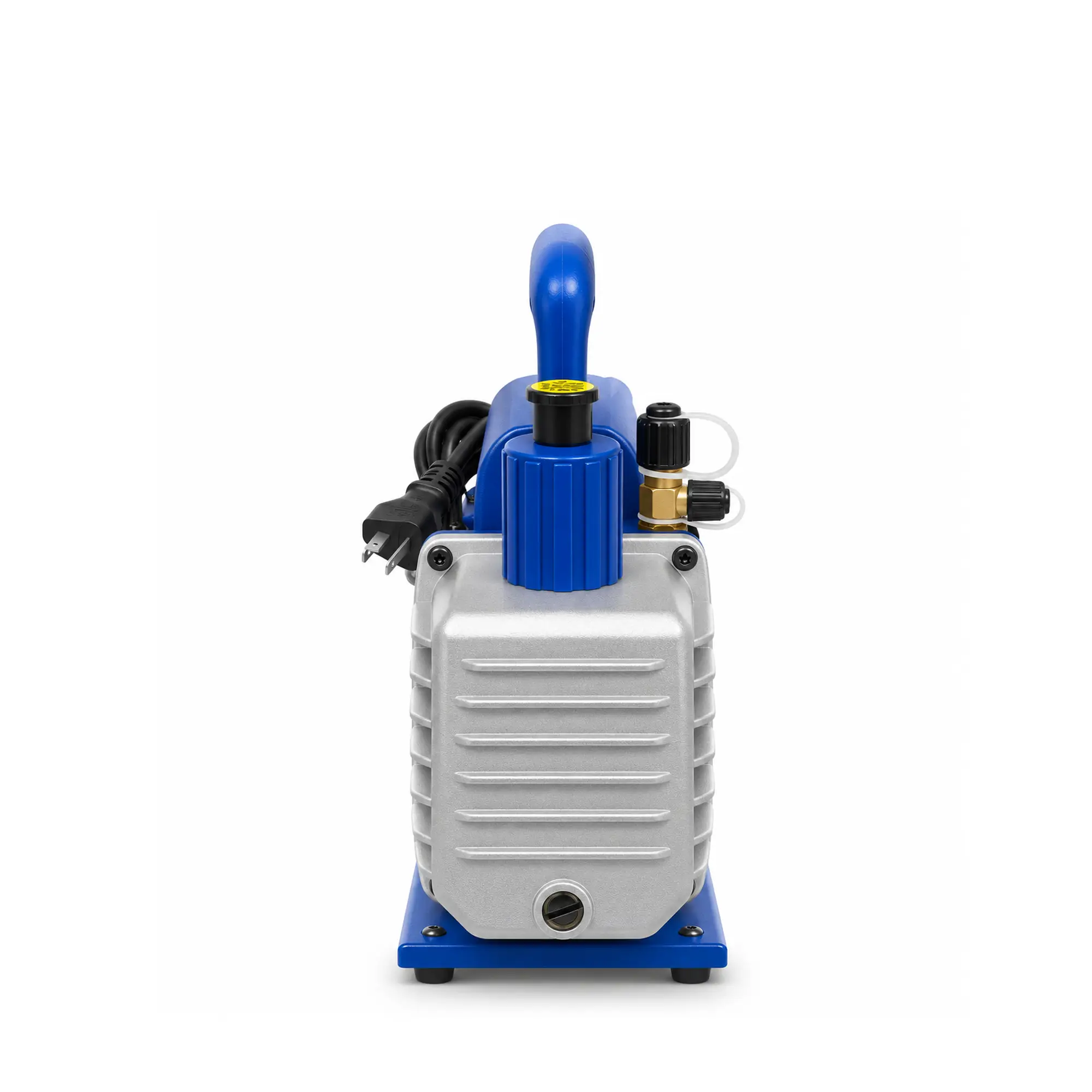
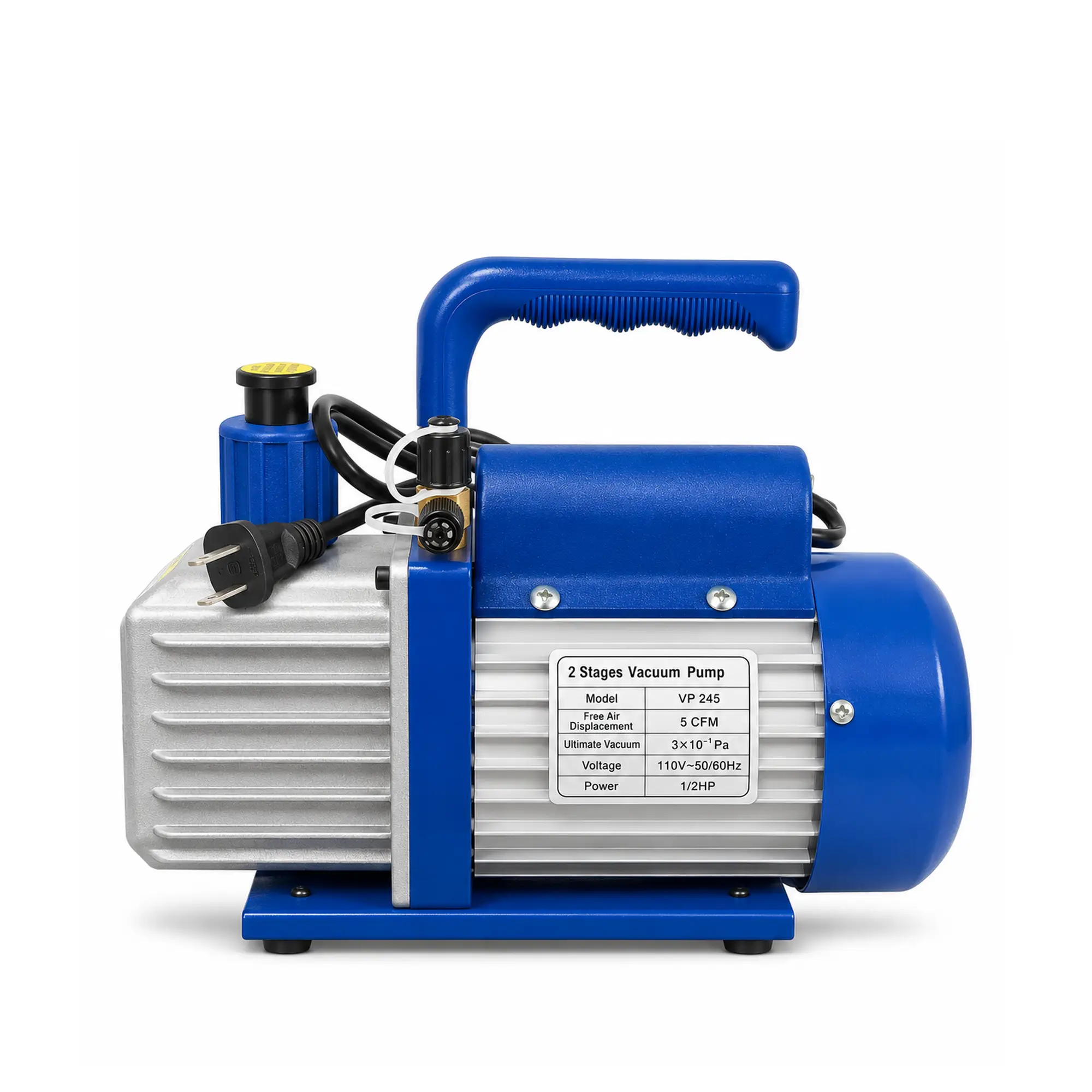
Two stage vacuum pumb
The CARECLIM 2 stage vacuum pump series covers seven models for evacuating air-conditioning and refrigeration circuits before charging. Free air displacement ranges from 42 to 283 L/min at 220 V / 50 Hz and from 50 to 340 L/min at 110 V / 60 Hz. Compare the pumping capacity, inlet connections and dimensions to select a model for your service work or distribution range.
- Two-stage pumping design for HVAC/R evacuation
- Seven models, from VP215 to VP2100
- 220 V / 50 Hz and 110 V / 60 Hz versions
- 1/4-inch flare or 1/4-inch and 3/8-inch flare inlets, depending on model
2 Stage Vacuum Pump product overview
An opened refrigerant circuit contains air and may have absorbed moisture during installation or repair. Evacuation removes gas from that circuit before refrigerant is introduced. The VP two-stage vacuum pump series gives service contractors and distributors a choice of capacities within one product range, with separate electrical versions for different power supplies.
In a two-stage rotary vane arrangement, gas passes through an inlet stage and then a second pumping stage before discharge. The second stage lowers the pressure against which the first stage exhausts. This arrangement allows lower ultimate pressures than a comparable single-stage design. The rated ultimate pressure of the particular pump still determines its suitability for a specified evacuation target.
Pump oil seals internal clearances and lubricates moving surfaces. Oil condition therefore affects the pressure the pump can achieve. Moisture also has to evaporate before it can leave the circuit as vapor, so a damp system can take longer to evacuate than dry, newly assembled pipework. Stage count and motor running time alone do not establish that evacuation is complete.
Features
A capacity range for different service requirements
At 50 Hz, VP215 and VP225 provide 42 and 70 L/min respectively. VP235 and VP245 increase this to 100 and 128 L/min, while VP260, VP280 and VP2100 cover 170, 226 and 283 L/min. This spread lets a distributor compare compact and higher-capacity models without moving to a different series. The required final pressure and the connection layout should be assessed alongside flow.
Inlet options matched to the model
VP215 and VP225 have a 1/4-inch flare inlet. VP235 through VP2100 have 1/4-inch and 3/8-inch flare connections. The larger connection offers another hose-routing option when the rest of the evacuation setup supports it. Match the hose fitting, sealing surface and vacuum rating; an adapter may make a connection possible while still leaving a narrow flow path.
Electrical versions identified separately
The series lists 220 V / 50 Hz and 110 V / 60 Hz versions, with a separate displacement rating for each. For example, VP235 is listed at 100 L/min for 50 Hz and 114 L/min for 60 Hz. Specify both voltage and frequency in an order so the quoted capacity matches the destination supply. These entries describe separate versions and do not establish a switchable dual-voltage motor.
Dimensions and weight for practical handling
The listed dimensions range from 270 × 119 × 216 mm for VP215 to 390 × 140 × 250 mm for VP2100; net weight ranges from 6 to 16 kg. For mobile service teams, compare these figures with vehicle storage, carrying distance and the available working surface. Allow room for hose connections and ventilation in addition to the pump’s listed dimensions.
Technical Specifications
Pumping stages: Two-stage
Free Air Displacement
The figures below are free air displacement ratings for the stated electrical versions. Actual evacuation speed at the system also depends on pressure, hose and port restrictions, leakage and moisture load. CFM and L/min are shown as listed for each version.
| Model | 220 V / 50 Hz (L/min) | 220 V / 50 Hz (CFM) | 110 V / 60 Hz (L/min) | 110 V / 60 Hz (CFM) |
|---|---|---|---|---|
| VP215 | 42 | 1.5 | 50 | 1.8 |
| VP225 | 70 | 2.5 | 84 | 3 |
| VP235 | 100 | 3.5 | 114 | 4 |
| VP245 | 128 | 4.5 | 142 | 5 |
| VP260 | 170 | 6 | 198 | 7 |
| VP280 | 226 | 8 | 254 | 9 |
| VP2100 | 283 | 10 | 340 | 12 |
Connections, Power and Physical Data
| Model | Inlet connection | Motor power (HP) | Oil capacity (mL) | Dimensions (L × W × H, mm) | Net weight (kg) |
|---|---|---|---|---|---|
| VP215 | 1/4″ Flare | 1/4 | 180 | 270 × 119 × 216 | 6 |
| VP225 | 1/4″ Flare | 1/4 | 280 | 278 × 119 × 216 | 7 |
| VP235 | 1/4″ & 3/8″ Flare | 1/3 | 360 | 320 × 134 × 232 | 11 |
| VP245 | 1/4″ & 3/8″ Flare | 350 | 320 × 134 × 232 | 11.8 | |
| VP260 | 1/4″ & 3/8″ Flare | 700 | 370 × 140 × 250 | 15 | |
| VP280 | 1/4″ & 3/8″ Flare | 600 | 370 × 140 × 250 | 15.5 | |
| VP2100 | 1/4″ & 3/8″ Flare | 1 | 700 | 390 × 140 × 250 | 16 |
Ultimate Vacuum
| Model | Ultimate vacuum (Pa) |
|---|---|
| VP215 | |
| VP225 | |
| VP235 | |
| VP245 | |
| VP260 | |
| VP280 | |
| VP2100 |
Selecting a Model
Begin with the equipment manufacturer’s evacuation requirement and the electrical supply, then compare displacement and connection options. VP215 and VP225 are the smallest listed units and suit a shortlist where carrying size is important. VP235 and VP245 share the same listed dimensions and add the 3/8-inch inlet option. VP260 and VP280 also share dimensions but have different displacement ratings; VP2100 has the highest listed displacement and a longer body.
For a distributor building a stock range, these groupings provide a starting point for comparing size and capacity. For an individual job, assess the connected circuit volume, service access and required final pressure. The series ratings do not define a fixed air-conditioning tonnage or a guaranteed evacuation time for each model.
Applications
Air-conditioning installation
Use a suitable two-stage HVAC vacuum pump to evacuate field-installed refrigerant pipework after assembly and the required leak test. This prepares the opened circuit for charging or refrigerant release in accordance with the equipment instructions. On split-system installations, check how the service ports, hose length and vacuum gauge will be arranged before choosing the pump size.
Refrigeration repair and recommissioning
Evacuation is part of returning a circuit to service after a compressor, valve or pipe section has been replaced. Refrigerant recovery, repair and leak testing come first. For cold-room and other commercial refrigeration work, consider which parts of the circuit are connected during evacuation and how long the system has been open to atmosphere. A suitable pump must meet the system’s pressure requirement under the planned setup.
Contractor equipment and distributor selections
The seven-model range allows purchasing teams to compare electrical versions, connection sizes and handling requirements in one table. A service kit specification should also identify the vacuum gauge, suitable hoses and any required adapters. List those items separately in the inquiry so the requested equipment package is clear.
Frequently Asked Questions
Does a two-stage pump evacuate twice as fast as a single-stage pump?
No. “Two-stage” describes the pumping arrangement. Its main advantage over a comparable single-stage design is the ability to reach lower pressure. Evacuation time depends on the displacement rating and the complete system setup, including restrictions and moisture. Compare both the required final pressure and the flow rating when choosing between designs.
Will VP2100 always complete a job faster than VP215?
VP2100 has the higher free air displacement rating. How much that changes the job time depends on the connection path and the system. A restrictive service port or a long, narrow hose can limit effective pumping speed. Choose capacity together with the hose arrangement and service access, rather than assuming that the ratio between catalogue flow figures is also the ratio between evacuation times.
Can a 220 V / 50 Hz unit be used on a 110 V / 60 Hz supply?
Specify the version that matches the supply. The two voltage and frequency combinations in the table are separate product versions. They are not an instruction to change the operating voltage of one pump. Include the required plug type when requesting a quotation.
Can the pump be used for R32 or R290 service?
Selection for flammable-refrigerant service requires explicit suitability for the exact pump version and the intended procedure. Two-stage construction and a matching hose fitting do not establish that suitability. Include the refrigerant and service application in your inquiry so the proposed configuration can be assessed against the required documentation.